
Research
As a member of the ODU Tick Lab, I build mechanistic models, such as age-structured and cohort-based simulations, to explore how tick life cycles, host interactions, weather patterns, and pathogen dynamics influence disease risk. I integrate methods from differential equations, agent-based modeling, and statistical analysis to investigate questions like: How do environmental variables shape tick phenology? What host-pathogen relationships drive transmission hotspots? And how can modeling inform public health strategies? My work bridges ecology, epidemiology, and mathematics to generate actionable insights into vector-borne disease systems.
In this video interview, I was featured as part of ODU’s Women’s History Month celebration, representing my department and sharing my journey in science. I spoke about my major, research, future goals, and how ODU is helping me achieve them. Watch the full video to learn more about my aspirations!
Current Projects
* Indicates projects where I served as a mentor or co-mentor to undergraduate students.
ADTSIM 2.0: An updated simulation of American dog tick (Dermacentor variabilis Acari: Ixodidae) population dynamics
ADTSIM 2.0 is a discrete-time model developed to simulate the life cycle and ecological dynamics of the American dog tick, a widespread vector of human and veterinary pathogens in North America. Adapted from Dr. Holly Gaff’s LYMESIM 2.0 framework, it models tick development through larval, nymphal, and adult stages on a weekly time step. The model incorporates parameters like questing behavior and temperature-dependent survival to examine how environmental conditions, host availability, and tick biology shape population densities. ADTSIM 2.0 lays the groundwork for modeling pathogen transmission and evaluating tick control strategies. It was also used in a collaborative study, Impaired humidity sensing reduces tick survival by preventing water homeostasis, to explore how sensory disruption influences tick survival under varying environmental conditions.
 |
|---|
 |
 |
See:
-
2024 American Mathematical Society (AMS) Spring Southeastern Sectional Meeting
-
Poster for Mid-Atlantic Tick Summit 13
-
1st Annual GSGA Conference
Collaborators: Oleksii Dubovyk, Sadie Jane Ryan, Chi Wei, MyKenna Zettle, Holly Gaff
 |
|---|
 |
 |
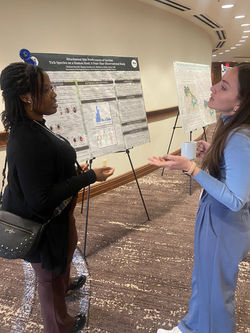
This project explored where ticks most commonly attach on the human body, focusing on three species found in our region: the American dog tick, blacklegged tick, and lone star tick. We analyzed 234 ticks collected over a four-year period (2018–2021) from a naturalist who carefully documented the dates and locations of each tick removal. Ticks were identified by species and life stage, and attachment sites were categorized by body region (head, trunk, arms, legs). Using Pearson’s Chi-Squared test in R, we found significant, species-specific preferences for attachment sites. I co-mentored undergraduate student, Chekeyl Harold, on this project, which earned 1st place in the student poster competition at the 78th Annual Virginia Mosquito Control Association Conference in Newport News, VA.
*Attachment Site Preferences of Various Tick Species on a Human Host: A Four-Year Observational Study
 |
|---|
 |
 |
Collaborators: Chekeyl Harold*, MyKenna Zettle, Holly Gaff
See:
*TickBot: Engineering a Smarter Solution for Tick Control
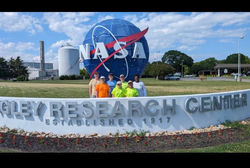
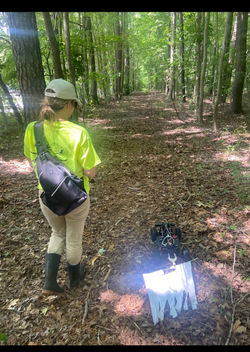
TickBot is a semi-autonomous robot designed to reduce tick populations with minimal environmental impact. Fitted with permethrin-treated denim and guided by a CO₂-laced magnetic trail, TickBot lures and eliminates ticks in natural environments. Early field trials demonstrated near-total tick reduction within 1 hour, with residual effects lasting up to 24 hours. Its design was improved as part of a CDC-funded initiative through the Southeastern Center of Excellence in Vector-Borne Diseases. In partnership with NASA Langley Research Center, this project explores TickBot’s long-term efficacy and the potential for responsive tick control strategies. Our goal is to determine how often TickBot needs to be deployed to maintain low tick densities and assess its performance across varied terrain and field conditions. I also co-mentor undergraduate interns who are contributing to this collaborative effort.
Collaborators: Dan Ejakov*, Ellie S.*, Jacob Knight*, Samantha Medrano*, Brian Rich, MyKenna Zettle, Holly Gaff
Previous Projects
M.S. Project: Optimizing Chlorophyll (Chl) Concentration Prediction in Arctic Sea Ice Using Supervised Machine Learning
This project applied supervised machine learning to improve predictions of chlorophyll concentration beneath Arctic sea ice. RGB images of the ice underside were reduced using Principal Component Analysis (PCA), and the extracted components were integrated with environmental sensor data to create a unified dataset. Several regression models were tested, with Random Forest and Gradient Boosting Regression showing the highest accuracy, achieving R² values of 88.3% and 88.9%, respectively. Under 5-fold cross-validation, these models maintained strong performance, with average R² values of 85.0% and 87.5%. This was an immense increase from previous efforts that achieved about 65% accuracy solely using a Convolution Neural Network.
 |
|---|
 |
 |
 |
Advisor: Guohui Song
* Indicates projects I participated in as a undergraduate
*The Spectrum Problem for the 4-Uniform 4-Colorable, 3-Cycles, with Maximum Degree 2
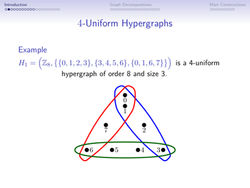
As part of the Illinois State University Math REU, I investigated a problem in hypergraph theory focused on decompositions of special 4-uniform hypergraphs. A hypergraph is a generalization of a graph where edges—called hyperedges—can connect any number of vertices, not just two. In this study, we focused on 4-uniform hypergraphs, where each hyperedge connects exactly four vertices, and specifically on 3-cycles with maximum degree 2 that are 4-colorable. These structures were derived by extending the classic 3-cycle to the 4-uniform case. We classified all such hypergraphs up to isomorphism and identified two with chromatic number 4. Our work established necessary and sufficient conditions for decomposing the complete 4-uniform hypergraph into these 3-cycles. I presented this research during my undergraduate years, and it later contributed to a published paper in combinatorics.
Mentors: Ryan Bunge, Saad El-Zanati, William Turner
Collaborators: Julie Kirkpatrick, Michael Severino
 |
|---|
 |
 |
*Using Mean As A Balance Point to Create a Zoo
 |
|---|
 |
 |
 |
This lesson plan, presented at the 2022 Virginia Council of Teachers of Mathematics Conference and published in The Virginia Mathematics Teacher journal, engages middle school students in exploring the concept of mean as a balance point through a creative, student-centered activity. Over the course of three 90-minute class sessions, students use problem-based learning to design and build a fictitious zoo animal, applying statistical concepts to calculate and represent the mean of data sets on a number line. The lesson challenges students to think critically about how adding, removing, or altering data points affects measures of center, while also encouraging communication, collaboration, and creativity. Originally implemented in a virtual urban classroom, the lesson is flexible and adaptable to a variety of instructional settings.